Introduction
Ladakh has moved from a niche adventure destination to one of the highest-demand mountain circuits in Indian domestic and inbound travel. Every summer season, travel agencies across Delhi, Mumbai, Bangalore, and increasingly from international markets, scramble to lock in Leh Ladakh B2B packages before hotel and camp inventory dries up in Nubra and Pangong.
The problem is that Ladakh doesn’t behave like a typical tourist circuit. A single missed acclimatization day can put a client in a hospital in Sonam Norboo Memorial Hospital. Inner Line Permits (ILPs) need advance processing through the DC office or authorized agents. Mountain passes like Khardung La, Chang La, and Umling La can shut without warning due to weather, landslides, or army convoy movement. Vehicles need union clearance, and non-local taxis routinely get stopped at checkpoints.
This is precisely why the choice of ground partner determines whether a B2B trip goes smoothly or turns into a reputational disaster for the selling agency. A reliable Ladakh B2B travel agency or DMC absorbs all of this operational risk on your behalf. This guide breaks down everything a travel agency, tour operator, or group organizer needs — itineraries, costs, permit handling, vehicle logistics, and how to structure your B2B partnership for maximum margin and minimum risk.
Section 1: Why Travel Agencies Need a Local Ladakh DMC
Selling Ladakh from Delhi or Mumbai without a local partner on the ground is one of the most common mistakes new tour operators make. Here’s what a genuine local DMC brings that a remote reseller simply cannot replicate.
Local Fleet Availability
A Leh-based Leh Ladakh tour operator maintains direct relationships with the local taxi union and owns or leases:
- 4×4 Toyota Innova / Innova Crysta — the workhorse vehicle for Nubra, Pangong, and Umling La routes, essential once you’re off tarmac past Durbuk or on the Wari La stretch.
- Tempo Travellers (12–17 seater) — used for group/FIT movements on the Leh-Sham Valley loop and airport transfers.
- Royal Enfield Himalayan and Classic 350cc fleets — maintained with fresh tyres, oil changes, and altitude-tuned carburetors specifically for Leh Ladakh bike trip clients.
- Backup vehicles on standby — critical during peak season (June–August) when breakdowns on the Nubra or Pangong route can otherwise strand a group for hours.
Direct Hotel and Camp Inventory
A local DMC holds block inventory — not just booking access — in:
- Leh town (3-star hotels, boutique properties, homestays)
- Nubra Valley camps (Hunder and Diskit) — Swiss cottage tents, deluxe tents with attached washrooms, and luxury camps with heaters
- Pangong Tso lakeside camps (Spangmik, Man, Merak)
- Emergency backup rooms during flight-delay cascades, which happen often given Leh airport’s weather sensitivity
This direct inventory access means a genuine DMC can hold rooms without pre-payment risk and rebook instantly when itineraries shift — something a reseller working off third-party OTAs cannot do.
Emergency Medical Support
This is the single most important differentiator. Ladakh sits at 11,500+ feet, and Khardung La, Chang La, and Umling La cross 17,000–19,000 feet. A competent ground operator provides:
- Oxygen cylinders stocked in every vehicle during the Nubra, Pangong, and Umling La legs
- Trained drivers who recognize early signs of Acute Mountain Sickness (AMS) — headache, nausea, breathlessness, disorientation
- Tie-ups with SNM Hospital Leh and military medical posts along high-altitude routes for emergency evacuation
- A mandatory rest-and-descend protocol built into itineraries rather than treated as an afterthought
Agencies that skip this due diligence when selecting a partner are the ones that end up handling insurance claims and negative reviews.
Section 2: Breakdown of Popular B2B Itineraries
5N/6D Classic Leh-Ladakh Route
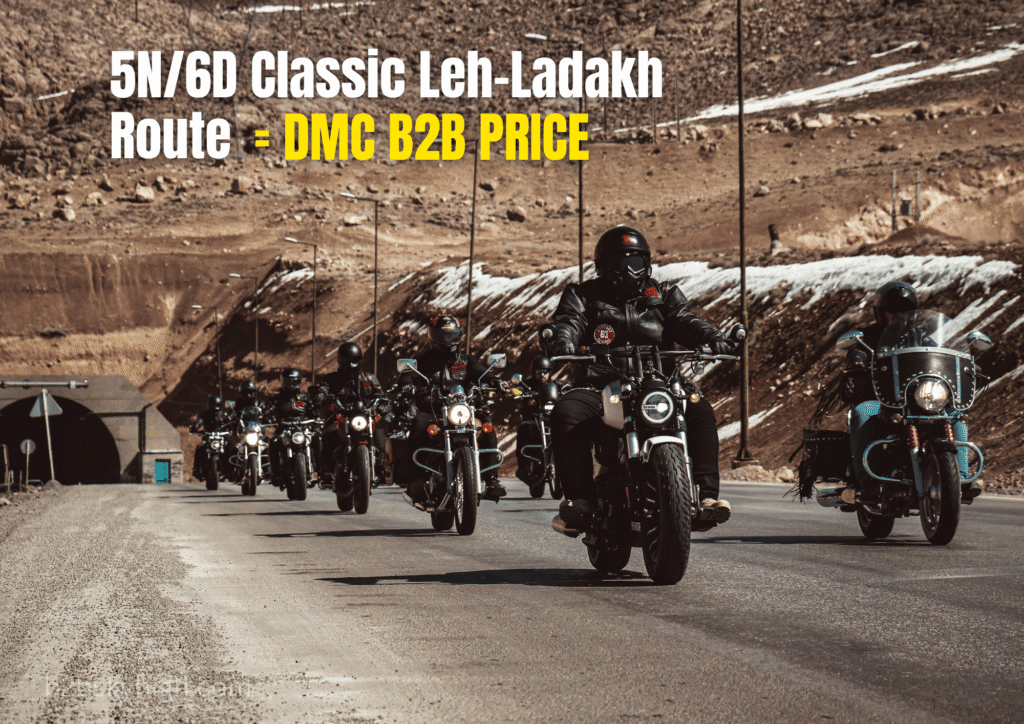
This is the bread-and-butter itinerary for most Leh Ladakh B2B package sales — ideal for first-time travelers, families, and groups with limited time.
| Day | Route | Key Operational Notes |
|---|---|---|
| Day 1 | Arrival Leh, full rest | Mandatory acclimatization — no sightseeing, oxygen levels monitored, light walking only |
| Day 2 | Local Leh sightseeing (Shanti Stupa, Leh Palace, Hall of Fame) | Low-altitude activity to continue acclimatization; ILP processing completed same day |
| Day 3 | Sham Valley excursion (Magnetic Hill, Sangam, Alchi/Likir) | Day trip, returns to Leh; good buffer day before high passes |
| Day 4 | Leh to Nubra via Khardung La (17,982 ft) | Early departure by 7 AM to avoid pass traffic; ILP checked at South Pullu checkpoint; overnight in Nubra Valley camps |
| Day 5 | Nubra to Pangong via Shyok route | Camel safari at Hunder optional; Shyok river route avoids re-crossing Khardung La; overnight lakeside camp at Pangong |
| Day 6 | Pangong to Leh via Chang La, departure | Early breakfast, return via Karu; airport drop timed against typical afternoon flight delays |
Operational insight: Agencies should never sell this itinerary with Day 1 sightseeing included. DMCs that agree to “compressed” acclimatization schedules to please agents are cutting corners that create liability.
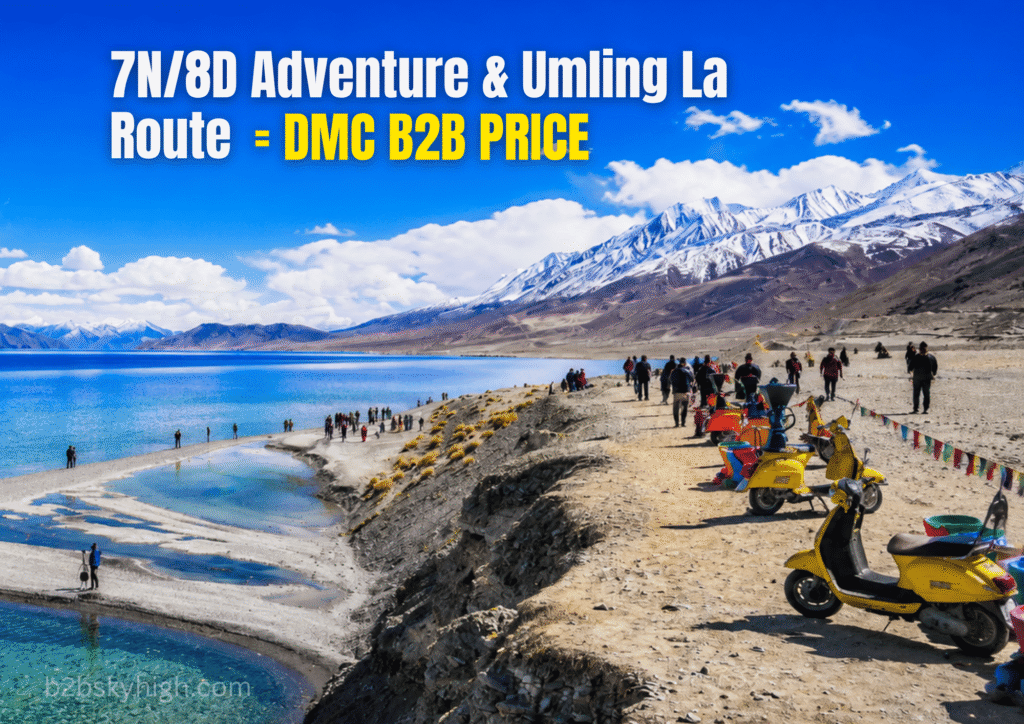
7N/8D Adventure & Umling La Route
This itinerary targets premium clients and adventure groups wanting the Umling La route planning experience — the world’s highest motorable pass at 19,024 ft.
| Day | Route | Key Operational Notes |
|---|---|---|
| Day 1–2 | Leh arrival + acclimatization + local sightseeing | Same as above, non-negotiable |
| Day 3 | Sham Valley | Buffer/acclimatization day |
| Day 4 | Leh–Nubra via Khardung La | Standard Nubra camp night |
| Day 5 | Nubra–Pangong via Shyok | Lakeside camp |
| Day 6 | Pangong–Hanle via Chushul-Loma road | Restricted route requiring special ILP annexure; Hanle is a Dark Sky Reserve — night astronomy add-on possible |
| Day 7 | Hanle–Umling La–Hanle/Leh | Summit run to Umling La; requires 4×4 vehicles only, oxygen mandatory in-vehicle, weather-dependent closure risk |
| Day 8 | Return Leh, departure | Buffer day built in for weather delays on Day 7 |
Operational insight: The Hanle-Umling La sector requires vehicles with valid permits for the restricted zone near the China border, and DMCs must apply for these at least 3–5 working days in advance. This is the itinerary segment where agencies most frequently get stuck if their ground partner isn’t well-connected with the DC office.
Section 3: Comprehensive Bike Trip Cost & Planning
The Leh Ladakh bike trip cost structure is one of the most-asked questions from both B2B agents and end consumers. Here’s the real cost breakdown for a 7-day self-ride package.
Bike Rental Comparison
| Bike Model | Per Day Rate (Approx.) | Best Suited For |
|---|---|---|
| Royal Enfield Himalayan 411cc | ₹2,200–2,800/day | Off-road stretches (Nubra sand dunes, Umling La), better ground clearance |
| Royal Enfield Classic/Bullet 350cc | ₹1,800–2,300/day | Tarmac-heavy routes, riders preferring classic ergonomics |
| RE Himalayan 450 (new gen) | ₹2,800–3,500/day | Premium clients, longer circuits including Hanle-Umling La |
Additional Cost Components
- Mechanic support van: ₹3,500–5,000/day for a group of 8–12 bikes — non-negotiable for any serious B2B bike package; carries spare clutch cables, brake pads, and tools
- Fuel costs: Budget ₹150–200/day per bike; last fuel pump before Nubra is at Khardung La base, and before Umling La is at Hanle — riders must carry reserve fuel
- Riding gear rental: Jacket, gloves, knee guards — ₹500–800/day if not owned by the rider
- Backup vehicle for luggage: Essential since riders can’t carry full luggage on bikes; usually bundled into the tempo traveller or Innova cost
- Helmet and communication devices: Intercom-enabled helmets recommended for group rides, ₹300–500/day rental
Sample 7-Day Bike Trip Cost Per Person (Group of 6)
| Component | Cost (INR) |
|---|---|
| Bike rental (7 days, Himalayan 411) | ₹17,500 |
| Fuel | ₹1,200 |
| Accommodation (mix of hotel + camps) | ₹14,000 |
| Meals (breakfast + dinner) | ₹4,500 |
| Mechanic van + backup vehicle (shared) | ₹3,000 |
| Permits (ILP + protected area) | ₹800 |
| Total per person (approx.) | ₹41,000 |
This range shifts ±15% depending on season (July-August peak vs September shoulder season) and bike model chosen.
Section 4: Comparison Table — B2B Rates vs Local Direct Ops
Understanding the margin structure is critical for agencies pricing their own retail packages. Below is a realistic breakdown of B2B ground handling Leh rates versus what a walk-in traveler pays booking direct.
| Component | B2B DMC Rate (Agent Cost) | Local Direct/Retail Rate | Typical Agent Margin |
|---|---|---|---|
| Innova Crysta (per day, Leh local + Nubra/Pangong) | ₹4,500–5,500 | ₹6,500–7,500 | 25–35% |
| 3-Star Hotel Leh (double occupancy, per night) | ₹2,800–3,500 | ₹4,000–5,000 | 30–40% |
| Standard Nubra/Pangong Camp | ₹3,200–3,800 | ₹4,500–5,500 | 25–35% |
| Luxury Camp (heated, attached washroom) | ₹6,000–7,500 | ₹9,000–11,000 | 30–40% |
| Permit Handling (ILP + Protected Area, per person) | ₹150–250 (bulk processing) | ₹400–600 (individual processing) | Bundled service value |
| Full 6D/5N Package (per person, twin sharing) | ₹16,000–19,000 | ₹24,000–28,000 | 35–45% |
Key takeaway: Agencies working directly with an established DMC rather than a sub-agent chain typically retain 10–15% more margin, since every intermediary layer compresses the final markup available to the retail-facing agency.
Section 5: Important Permits, Regulations & Safety Protocols
Inner Line Permits (ILP)
Ladakh’s border-sensitive geography means most tourist routes outside Leh town require an Inner Line Permit:
- Required for Nubra Valley, Pangong Tso, Tso Moriri, and Hanle
- Applied for online via the Ladakh administration portal or through registered local travel agents
- Indian nationals: processed same-day in most cases
- Foreign nationals: require Protected Area Permits (PAP), processed in groups of minimum 2, with additional documentation and longer lead time
- A competent DMC bulk-processes these for B2B groups, cutting cost and turnaround time significantly compared to individual applications
Local Union Transport Rules
The Leh Taxi Union operates a tightly controlled system:
- Non-local vehicles (registered outside Ladakh/J&K, e.g., Delhi or Chandigarh plates) are frequently restricted or taxed heavily on tourist routes
- Union vehicles have designated route rights; using an outstation vehicle for point-to-point sightseeing can result in the vehicle being turned back at checkpoints
- B2B agencies must confirm their DMC uses union-registered vehicles to avoid mid-trip disruptions — this is a recurring complaint among agencies who tried to bring vehicles from outside
Mandatory 48-Hour Acclimatization Rule for Flyers
- Anyone arriving in Leh by air is strongly advised — and in several tour insurance policies, contractually required — to rest for the first 24–48 hours before undertaking strenuous activity or ascending further
- Hotels and DMCs in Leh are expected to enforce this; agencies that pressure operators to skip it expose clients to real AMS risk and themselves to liability
- Road travelers (via Manali or Srinagar) acclimatize gradually during the drive, so the rule applies primarily to flight arrivals
Section 6: Frequently Asked Questions
What is the average Leh Ladakh trip cost per person? For a standard 6D/5N package with 3-star hotels and twin-sharing camps, budget ₹16,000–24,000 per person for B2B/group rates, or ₹24,000–32,000 for retail/direct bookings, excluding flights. Adding Umling La and Hanle typically adds ₹6,000–9,000 per person due to the restricted-zone logistics and extra nights.
How do B2B travel agents get wholesale rates from Ladakh DMCs? Agents typically need to register with the DMC as a partner (business documents, GST details), after which they receive a rate card for the season. Volume commitments, advance booking windows, and repeat business usually unlock further tiered discounts of 5–10% beyond the standard B2B rate.
Is Ladakh safe for family group tours? Yes, with correct planning. The key risk factors are altitude sickness and road conditions on high passes, both manageable with proper acclimatization scheduling, oxygen support in vehicles, and choosing family-friendly itineraries that avoid overly compressed pass-crossing days.
What is the best time to book B2B packages for the summer season? Peak season (mid-June to August) inventory — especially Pangong lakeside camps and Umling La-route vehicles — should be locked in by March-April. Agencies waiting until May often find their preferred DMC’s premium camp inventory already committed to earlier bookings.
Partner With a Ladakh Ground Handling Team You Can Trust
Selling Ladakh well isn’t about undercutting on price — it’s about partnering with a Leh Ladakh tour operator who has real fleet ownership, real hotel and camp allotments, and real emergency response capability on the ground. That’s what protects your agency’s reputation when a pass closes unexpectedly or a client shows early AMS symptoms.
If you’re a travel agency or tour operator looking to add Ladakh to your portfolio or switch to a more reliable Best Ladakh DMC, reach out for:
- A current-season B2B rate card across hotels, camps, and vehicle categories
- Custom itinerary building for FIT, group, and adventure/bike segments
- Bulk ILP and permit processing support
- Dedicated ground operations contact for real-time trip support during the season
Get in touch today to request your B2B rate card and start building Ladakh packages your clients — and your margins — will thank you for.